


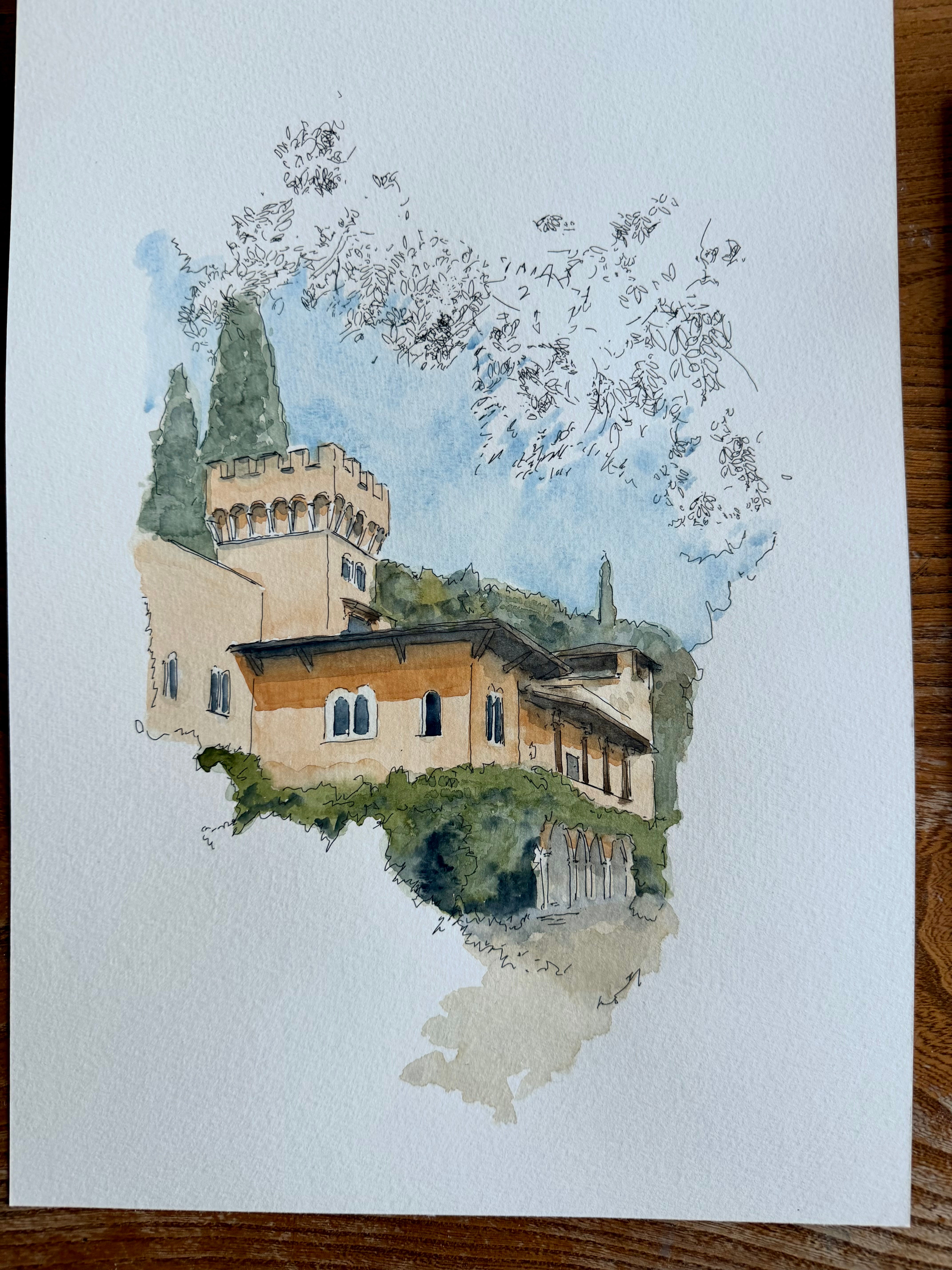

A Renaissance retreat above Florence. This watercolour captures Villa Le Fontanelle on the Careggi hills, its pale facade, terraces, and gardens look down towards the city and Brunelleschi's dome.
The villa began as a small farm, later acquired by the Medici family in the 15th century. Cosimo de' Medici gave it to the humanist Marsilio Ficino, who used it as a place of study and reflection while translating Plato's works. The property therefore became associated with the Florentine Neoplatonic Academy, a circle of scholars, artists, and thinkers who helped shape Renaissance intellectual life.
The villa's name "the little fountains' refers to the springs and ancient water systems on the hillside.
Sir John Francis Slone gave the villa much of its present appearance and redesigned the gardens in the Romantic style. During the Second World War, art historian Bernard Berenson was sheltered at the villa, which was regarded as neutral territory. Today the villa operates as a historic hotel, retaining its gardens, terraces, pool, chapel, and views over Florence.
Interesting facts...
The villa was given by Cosimo de' Medici to Marsilio Ficino specifically so he could translate Plato making it one of the few country houses directly linked to the birth of Renaissance philosophy.
Ficino's Platonic Academy was not a formal school but a circle of thinkers who met to discuss philosophy, art, and the soul; the mermaid statue in the marble pool is said to symbolise this intellectual world.
The villa's stone vaults, terracotta floors, and antique furnishings preserve traces of its long history beneath its later hotel comforts. The property is now a wedding venue, but its most famous guest was not a bride or groom t was a scholar hiding from war.
Location: Via di Careggi 26, Florence, Italy
