


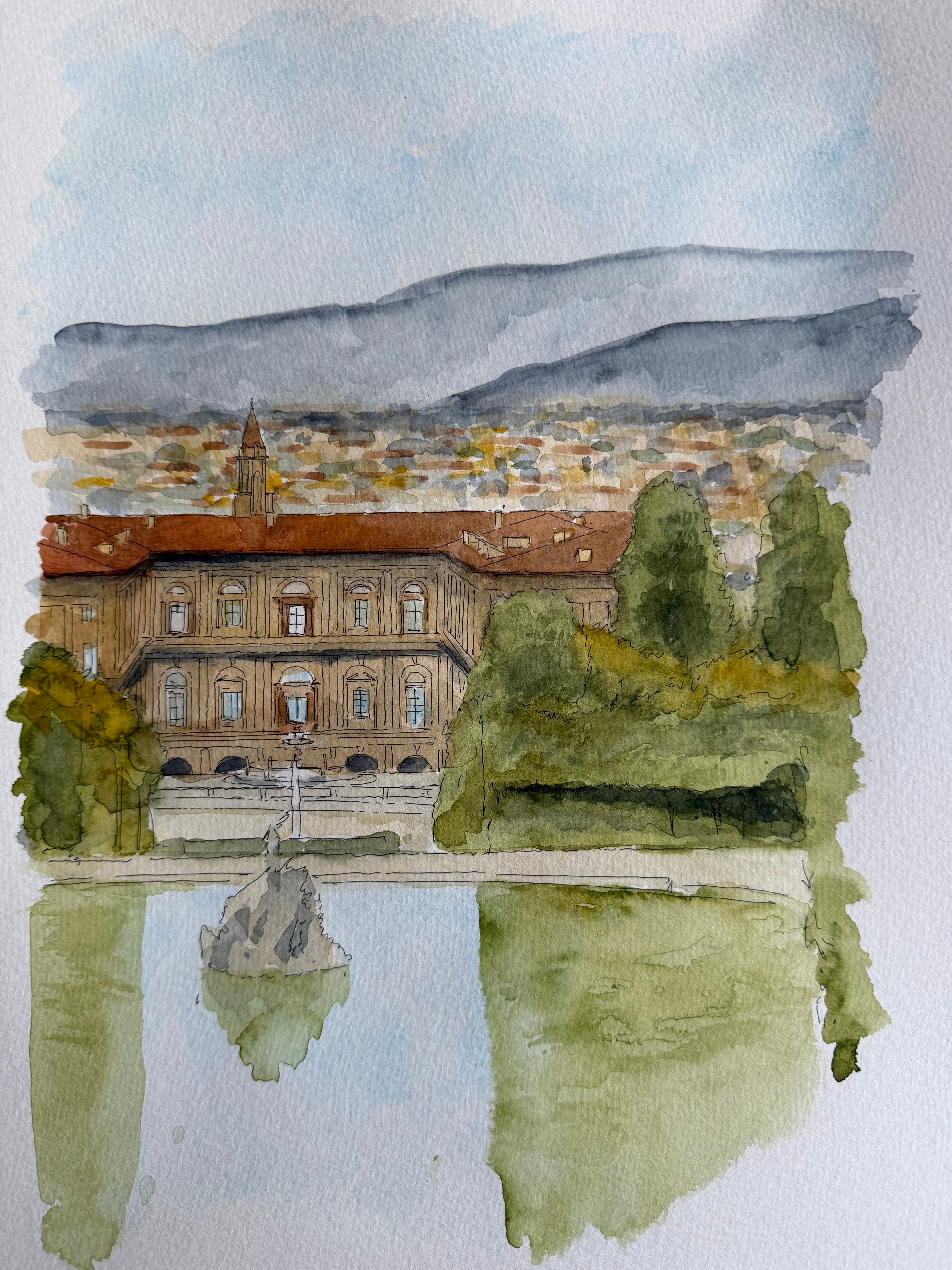

Seen from the Boboli Gardens, Palazzo Pitti rises along a formal axis towards the city and the Tuscan hills beyond. This watercolour captures the palace from an elevated garden viewpoint, the palace's massive rusticated facade at the centre, with Florence spreading below and the hills framing the horizon.
Palazzo Pitti began around 1458 as the residence of Florentine banker Luca Pitti, who wanted a palace to rival the Medici. The design is traditionally attributed to Filippo Brunelleschi, although it was more likely built by his pupil Luca Fancelli. In 1549, Eleonora di Toledo, wife of Cosimo I de' Medici, purchased the unfinished palace and transformed it into the principal residence of the Grand Dukes of Tuscany.
Bartolomeo Ammannati extended the palace and created its great courtyard, while Niccolò Tribolo began the Boboli Gardens behind it. Later architects, including Giorgio Vasari, Bernardo Buontalenti, Giulio Parigi, and Alfonso Parigi, expanded both palace and garden over three centuries. Under the Habsburg-Lorraine dynasty, the two front wings with porticos and terraces — the Rondò — were added. The palace later became a royal residence under the Savoy family and was donated to the Italian state in 1919. Today it houses major museums, including the Palatine Gallery, Royal Apartments, Gallery of Modern Art, and Costume Gallery.
Interesting facts...
Luca Pitti built the palace partly to challenge the Medici, yet his family was ruined by debt and the Medici eventually bought it turning their rival's dream home into their own grand residence.
Eleonora di Toledo purchased the unfinished palace in 1549 and immediately began creating the Boboli Gardens, making the garden as important to Medici power as the building itself. The gardens were designed as an outdoor theatre of authority and are still impressive today. The Buontalenti Grotto contains a marble Venus by Giambologna, hidden inside a cave-like chamber designed to surprise visitors.
The Boboli amphitheatre hosted some of the earliest operas ever performed, making the gardens a birthplace of modern musical theatre. Napoleon used the palace as a residence during his rule in Italy, and it later became home to King Victor Emmanuel II while Florence was the capital of Italy from 1865 to 1871. The Vasari Corridor connects Palazzo Pitti to the Uffizi across the Ponte Vecchio, allowing the Medici to move unseen above the city. The palace's rusticated stonework was deliberately rough and powerful, designed to project strength and permanence.
As with many important buildings there are always scandals...
Francesco, the Grand Duke of Tuscany, began an affair with Bianca Cappello while still married to Joanna of Austria. Bianca was herself already married, and her husband, Pietro Bonaventuri, was later murdered in the streets of Florence, perhaps by Francesco?
After Joanna died in 1578, Francesco secretly married Bianca and later made the marriage public, causing outrage because she was seen as socially unsuitable. The couple lived largely at Palazzo Pitti and died within hours of each other at Poggio a Caiano in 1587, prompting persistent rumours of poisoning.
Location: Piazza dei Pitti 1, Florence, Italy
