


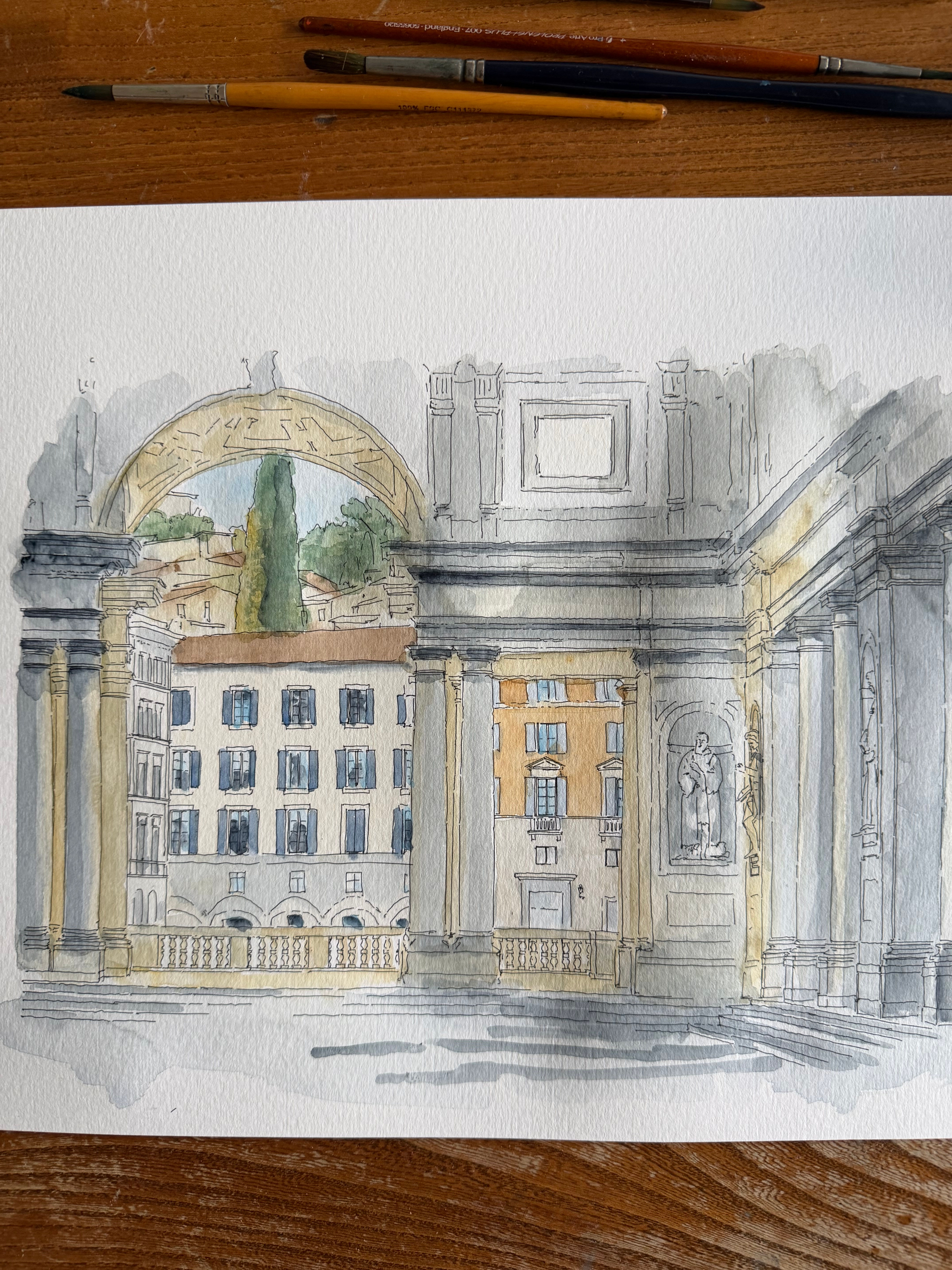

Looking through the great arch towards the Arno. This watercolour captures the Uffizi Gallery from its narrow courtyard, looking down past the colonnaded passage towards the large arched opening that frames the river.
. The Uffizi was commissioned by Cosimo I de' Medici in 1560 and designed by Giorgio Vasari as a single administrative headquarters for Florence's courts, guilds, and government offices — the word uffizi means offices. Vasari created a U-shaped building between Piazza della Signoria and the River Arno, replacing a crowded medieval quarter with one of the most influential architectural spaces of the Renaissance. The long courtyard was designed as a regulated urban street, with Doric columns, open loggias, and a continuous perspective that leads directly to the river. Construction continued after Vasari's death under Alfonso Parigi and Bernardo Buontalenti, and the building was completed in 1581. Later, the Medici transformed the offices into a gallery for their art collection, making the Uffizi one of the world's oldest public museums. In 1993, a bomb exploded nearby, damaging the gallery and killing five people, but the museum was restored and reopened. Today the Uffizi houses masterpieces by Botticelli, Leonardo da Vinci, Michelangelo, Raphael, Caravaggio, and many others.
Interesting facts...
The famous arch at the end of the courtyard was not originally a public viewpoint but part of a private Medici route towards the river. In 1565, Cosimo I ordered Vasari to build the Vasari Corridor — an elevated secret passageway from the Uffizi across the Ponte Vecchio to the Pitti Palace — in just five months for his son Francesco's wedding. The corridor allowed the Medici to move unseen above the streets, cross the river, and even attend Mass at Santa Felicita from a private balcony without mixing with ordinary worshippers. The corridor's 73 windows gave the Grand Dukes a controlled view of Florence, letting them observe the city while remaining hidden. The Uffizi's courtyard was built over a medieval neighbourhood of towers and houses, and Vasari demolished much of the old city to create his monumental perspective. The museum's first public opening came in 1765, when the Medici collection was transferred to the state after the family line ended. During the Second World War, the round windows over the Arno were altered for a wartime visit, changing the appearance of the riverfront facade. On 27 May 1993, a car bomb exploded near the Vasari Corridor, killing five people and damaging artworks; fragments of the shattered sculpture were later deliberately left visible in the museum as a memorial. The Uffizi's collection includes Botticelli's Birth of Venus and Primavera, Leonardo's Annunciation, Michelangelo's Doni Tondo, and Caravaggio's Medusa.
Vasari was not only an architect but also the author of Lives of the Artists, the book that helped define the idea of the Renaissance. The narrow courtyard is often described as the first regularised street in Europe, designed with mathematical precision to create a single, controlled perspective.
Location: Piazzale degli Uffizi 6, Florence, Italy
